Work with me
Southernmost Giants
After more than one century, elephants once again roam the Southern Cape, restoring an ecological relationship that shaped this landscape for millennia.Nikon Z7_2 | ISO-1000 | f/6.3 | 1/3200 sec. | 500mm
Southernmost Giants — secondary
Where Paths Converge. A Meeting of Herds.Nikon Z7_2 | ISO-1600 | f/6.3 | 1/1600 sec. | 600mm

WILD SYSTEMS | REWILDING | ECOLOGICAL CONNECTIVITY

Southernmost Giants

A story of return, remembrance and the ancient pathways that once connected the land.

Elephants do not simply move through a landscape. They reveal how connected it truly is.

Long before fences divided the landscape, elephants moved freely across southern Africa.

They followed the seasons, the rains and the availability of food, shaping the ecosystems around them as they travelled. Their movements connected landscapes, carried seeds and influenced the rhythms of the natural world in ways that continue to shape our understanding of ecological systems today.

Across much of their former range, those journeys were interrupted.

Ancient pathways became fragmented. Movement was restricted. The relationship between species and landscape was altered as human boundaries reshaped the natural world.

Yet some stories of return begin with simply allowing nature to move again.

In the Southern Cape, elephants are once again walking through fynbos-covered valleys and mountain landscapes from which they disappeared centuries ago. These are the southernmost free-roaming elephants in the world and represent the return of a breeding herd to a region where elephants had been absent for more than two hundred years.

Southern Cape elephants — photograph by Raquel de Castro Maia
Bathed in the golden light of evening, elephants revel in the simple joy of water. They swim, splash and play with a freedom that is unmistakable. Yet even in these moments of play, they are quietly shaping the landscape around them. As nature's greatest ecosystem engineers, elephants churn waterholes, create muddy wallows, disturb the soil and open pathways through the bush. These changes benefit amphibians, birds, insects and countless other species, creating habitats that support life long after the herd has moved on. What appears to be an evening of play is also an essential ecological process, carried out simply by elephants being elephants.Nikon Z7_2 | ISO-1600 | f/6.3 | 1/1600 sec. | 600mm

Perhaps one day, conservation will be measured not by the fences we build, but by the barriers we remove.

After a decade spent observing these remarkable animals, what remains most striking is not only their size, but the way they seem to belong.

Watching elephants move through the Cape Floristic Region feels less like an introduction and more like a reunion. Their presence awakens the possibility that some ecological memories persist long after a species has disappeared, waiting for the opportunity to emerge once again.

Season after season, they move through the landscape with a quiet confidence. They browse amongst the fynbos, follow familiar pathways and reshape the environment around them, carrying out the role they evolved to perform over millions of years.

Sometimes the wild doesn't need to be created. It simply needs a way back.

Southern Cape elephants — photograph by Raquel de Castro Maia
There is a quiet confidence in the way an elephant herd moves together. At the front walks the matriarch, her experience guiding every decision, every change in direction and every pause along the way. In following her, the younger generations inherit more than a route through the landscape; they inherit the knowledge needed to survive within it.Nikon Z7_2 | ISO-800 | f/6.3 | 1/3200 sec. | 150mm

Over time, I have watched new generations enter this landscape. Young calves now follow paths that their ancestors once travelled, carrying forward a story that is still being written.

Their return is about more than the presence of a species.

It is about restoring relationships.

Between animals and habitat.

Between movement and place.

Between the ecological processes that sustain life and the landscapes that depend upon them.

Protea neriifolia — photograph by Raquel de Castro Maia
Beneath every Protea neriifolia bloom lies a hidden reward. Rich nectar collects at the base of the flower, attracting elephants and baboons during the lean winter months. What begins as a simple meal becomes part of a much larger story, where plants nourish wildlife and wildlife, in turn, helps shape the living landscape.Nikon Z9 | ISO-320 | f/3.2 | 1/2000 sec. | 105mm
Cape Flightless Dung Beetle — photograph by Raquel de Castro Maia
Every elephant leaves behind more than footprints. Their dung provides food, shelter and opportunity for countless smaller creatures, including the Cape Flightless Dung Beetle. As these remarkable insects roll and bury dung, they recycle nutrients, improve soil health and disperse seeds, playing an essential role in the continual renewal of the landscape.Nikon Z9 | ISO-320 | f/3.2 | 1/2000 sec. | 105mm

The return of elephants is also the return of the countless lives that depend upon them.

The dream of rewilding has never been solely about bringing animals back. It is about creating the conditions for nature to function again, allowing landscapes to reconnect and giving species the freedom to respond to the seasons as they have done for millennia.

By corridors reopened.

By landscapes connected.

By the return of movement.

Until then, the elephants continue to walk.

Each footstep is a reminder that the past is not always lost.

Sometimes it is waiting for a path home.

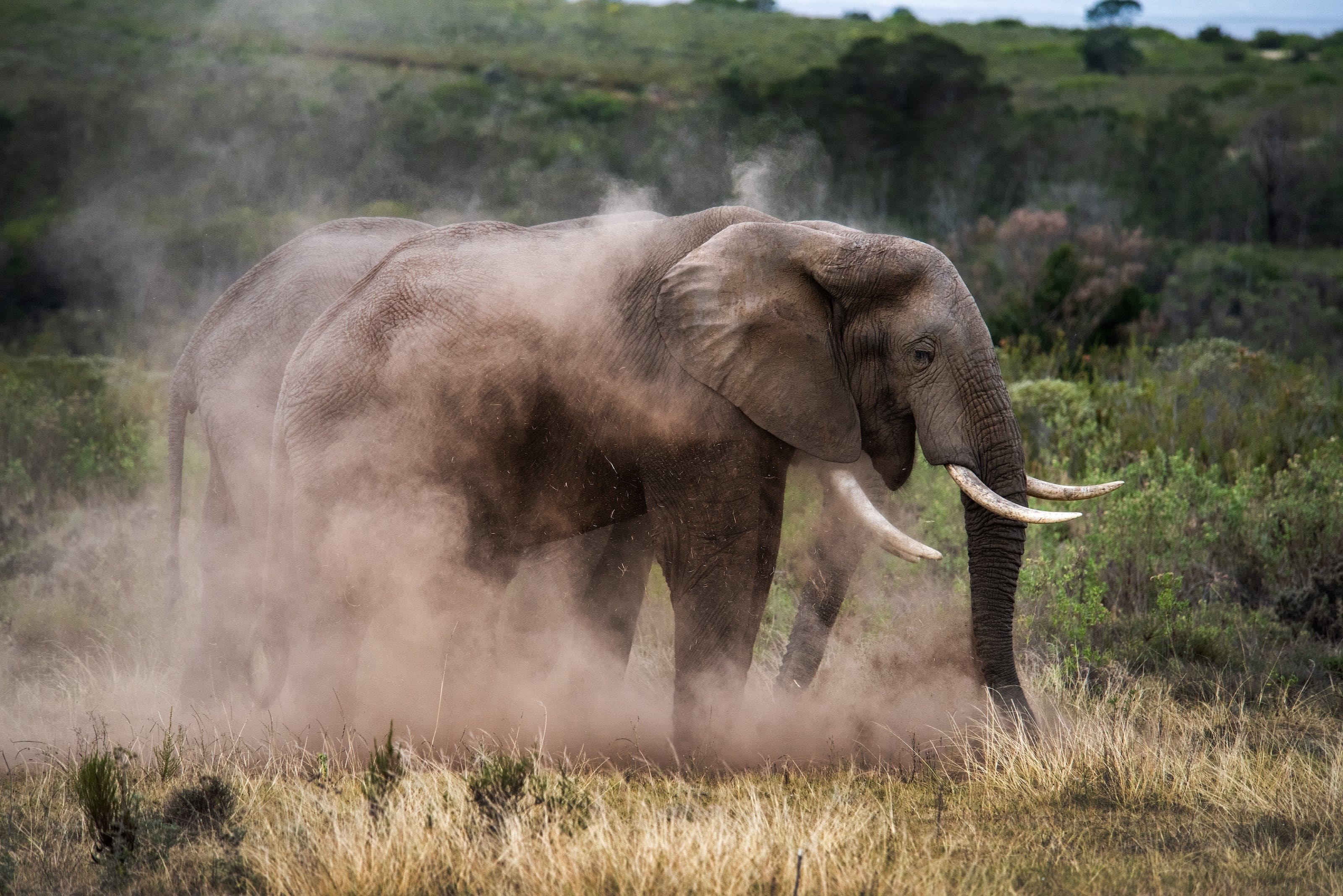
Southern Cape elephants — photograph by Raquel de Castro Maia
As dusk settles across the landscape, two bulls feed side by side, uprooting grasses to reach the energy-rich roots hidden beneath the soil. With each gentle shake, golden clouds of dust drift into the evening light before the roots disappear beneath their trunks. It is an unhurried ritual, yet one that has shaped these ecosystems for millennia. By disturbing the soil and creating space for new growth, elephants remind us that the landscape is not sculpted through grand events, but through the quiet rhythms of everyday life.Nikon Z7_2 | ISO-1600 | f/6.3 | 1/1600 sec. | 600mm
Let Me Tell Your Story →

Species Notes

The Southern Cape's elephant population represents one of South Africa's significant rewilding stories. Gondwana is home to the southernmost free-roaming elephant herd in the Western Cape and the first breeding herd to become established within a fynbos and renosterveld landscape in more than a hundred years. Their return provides an opportunity to better understand the ecological role of elephants within a unique landscape and the importance of connectivity in conservation.

Questions From the Field

Why do elephant movement corridors matter?

Before fences divided the landscape, elephants followed the seasons, the rains and the food, shaping ecosystems as they travelled. Their movements connected landscapes and carried seeds, and when those ancient pathways fragmented, that connective work was interrupted.

What does it mean to call them the southernmost elephants?

They sit at the southern edge of a range that once ran freely across southern Africa, which makes their presence a story about return and remembrance as much as about the animals themselves.

Do you document rewilding and reintroduction programmes?

Yes. I follow a landscape or a population over time, which is where this kind of story actually lives.

Can you cover a project across several seasons?

Yes. Some of my most useful work for reserves has been built over years rather than a single visit.

How do I commission a piece like this?

Get in touch with me and lets discuss what you need and when you would want it covered.

Can images from this story be licensed?

Yes. This usually means editorial use (a magazine or article), campaign use (marketing or advertising), or conservation-communication use (a conservation organisation's own reports or outreach material). Tell me what you need and where it will run.

How do elephants shape the landscape they return to?

As ecosystem engineers, they churn waterholes, create wallows and disperse seeds through their dung, work that benefits everything from amphibians to the Cape Flightless Dung Beetle long after the herd has moved on.

Species fact files

Fact file

African Bush Elephant

Loxodonta africana

Genus Loxodonta · Elephantidae

Endangered

Habitat
Diverse sub-Saharan habitats, savanna grassland, woodland, forest, wetland and farmland, from sea level to mountain slopes
Lifespan
Up to 70–75 years in the wild

Key facts

  • The largest living land animal: adult bulls stand roughly 3.0–3.4 m at the shoulder and weigh about 5.2–6.9 tonnes.
  • Both sexes grow ivory tusks throughout life; the longest recorded tusk measured 3.51 m and weighed 117 kg, the trait that drives the poaching crisis.
  • Herds are matriarchal: a family unit is led by the oldest female, who guides the group to food and water and coordinates cooperative care of calves.
  • Assessed for the first time as a species separate from the forest elephant in 2021 and listed as Endangered, with over 60% of the savanna population estimated lost since 1965.
RangeSub-Saharan Africa

Place

Gondwana Private Game Reserve

Type
Private game reserve (rewilded fynbos)
Region
Garden Route, near Mossel Bay, Western Cape

A rewilded former-farmland reserve in the Cape Floral Kingdom, restoring endangered fynbos and renosterveld habitats, and the wildlife that lived there before European settlement, alongside an active conservation foundation.

Key facts

  • ≈11,000 hectares on South Africa's southernmost coast, developed expressly to rewild the region
  • Free-roaming Big 5, including the world's southernmost free-roaming elephant herd, the first elephants re-established in a fynbos / renosterveld landscape
  • Over 1,000 fynbos plant species; a ~1,000-ha protected block for specialist species (bontebok, Cape mountain zebra, sable)
  • Site of the rediscovery of the Critically Endangered orchid Satyrium muticum, first found on 13 September 2017 by Raquel de Castro Maia; now the largest known population (6,000+ plants by 2020)
  • Endangered species present include Cape mountain zebra, bontebok, serval and brown hyena

Fact file

Oleanderleaf Protea

Protea neriifolia

Genus Protea · Proteaceae

Least Concern

Habitat
Fynbos Biome.

Key facts

  • A protea of the Fynbos Biome, photographed on Gondwana Private Game Reserve.
  • Cape Sugarbirds are specialist nectar feeders on proteas and important pollinators of many protea species.
  • The relationship between protea and sugarbird is one of the intricate partnerships that sustain the fynbos.