Work with me
Following the Elephants: A Corridor of Hope
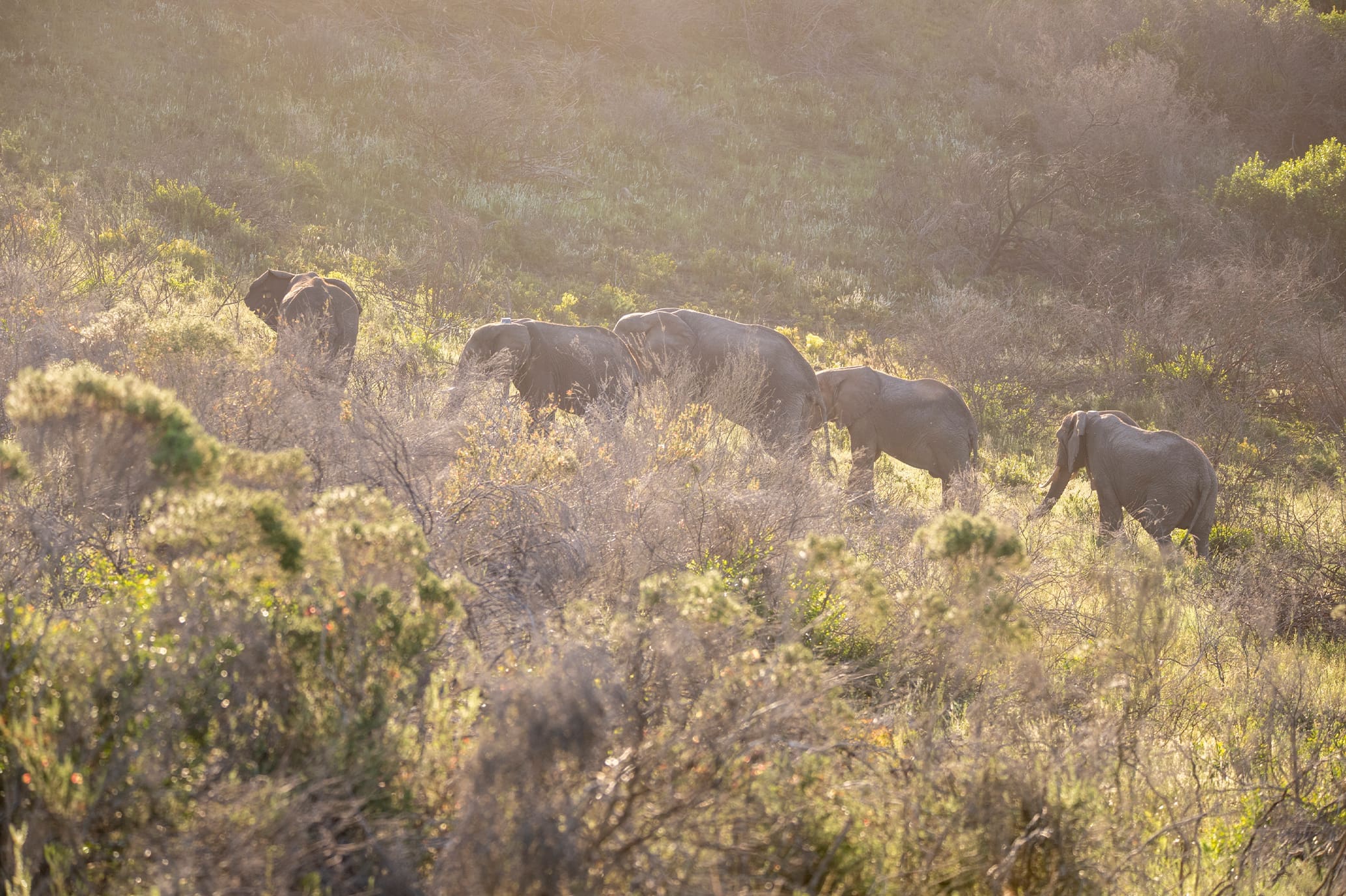
An elephant's skin carries the folds of every path it has walked. Some memories, it seems, are written into the body itself.Nikon Z7 | ISO-800 | f/6.3 | 1/1000 sec. | 600mm
Following the Elephants: A Corridor of Hope — secondary
This herd is not wandering. Elephants inherit their routes from generations before them, following food and water exactly as their ancestors did. It is only the fences that are new.Nikon Z6_2 | ISO-1000 | f/6.3 | 1/1000 sec. | 200mm

FIELD STORIES | REWILDING | ECOLOGICAL CONNECTIVITY

Following the Elephants: A Corridor of Hope

A landscape once divided is learning to move again. Across the southern Cape, an ambitious conservation initiative is working to reconnect fragmented habitats, restoring the pathways that allow wildlife, water, seeds and ecological processes to flow across the land once more.

At the edge of the Knysna Forest, where ferns gather beneath towering yellowwoods and mist drifts through ancient valleys, the memory of elephants still lingers.

For thousands of years, they moved through these landscapes, travelling between mountains, forests, thickets and coastal plains. Their journeys shaped ecosystems. Seeds were carried across vast distances. Pathways emerged through dense vegetation. Life moved with them.

Movement was once the language of the land.

Today, that language is being relearned.

Elephants on a mountain slope at sunset - Photograph by Raquel de Castro Maia
Backlit and half-hidden in the fynbos, this herd moves the way elephants have always moved here, unhurried, and exactly where they mean to be.Nikon Z9 | ISO-500 | f/5.3 | 1/320 sec. | 195mm
Stretching approximately 400 kilometres from the forests of Knysna to Addo Elephant National Park, the Eden to Addo Corridor Initiative is one of South Africa's most ambitious rewilding projects. Its vision is both simple and profound: to reconnect fragmented landscapes and restore the ecological processes that allow life to move freely once more.


The corridor traverses five of South Africa's nine major biomes — Forest, Fynbos, Thicket, Nama Karoo and Succulent Karoo — creating a living link between some of the most biologically diverse ecosystems on Earth.

Knysna dwarf chameleon - Photograph by Raquel de Castro Maia
Not every species that depends on this corridor is as large as an elephant. The Knysna dwarf chameleon (Bradypodion damaranum) is endemic to these afromontane forests, between the Outeniqua and Tsitsikamma Mountains, its entire world contained in a few branches, yet found in the very same landscape the lone elephant calls home.
Afromontane forests of the Western Cape - Photograph by Raquel de Castro Maia
Deep within the afromontane forests of the Western Cape, light barely reaches the ground. It is easy to understand how one elephant could remain hidden here for years.
Arum Lily Frog (Hyperolius horstockii) - Photograph by Raquel de Castro Maia
The Arum Lily Frog (Hyperolius horstockii), pale enough to disappear against the flower it's named for. Frogs move between wetland and land throughout their lives, which makes them one of the most reliable indicators of a landscape's health, and usually the first to disappear when that connection is cut off.
African Monarch (Danaus chrysippus) - Photograph by Raquel de Castro Maia
This African Monarch (Danaus chrysippus) doesn't migrate the way its famous American cousin does, but it is a wanderer all the same, following the rains to wherever its host plant has freshly sprouted. A fragmented landscape is no less a problem for a butterfly that needs to keep moving than it is for an elephant.
Bushbuck (Tragelaphus scriptus) - Photograph by Raquel de Castro Maia
A male bushbuck (Tragelaphus scriptus), not endemic to the region but widespread across roughly 73% of sub-Saharan Africa. What it does depend on is dense, connected cover, thicket and riverine vegetation close to water, exactly the kind of fragmented habitat the Eden to Addo Corridor Initiative is working to stitch back together.
Mountain fynbos, Western Cape - Photograph by Raquel de Castro Maia
Mountain fynbos like this forms one link in a much longer chain, one of five biomes the Eden to Addo corridor is working to keep connected, from these slopes down to the forests and coastline beyond.

Nature cannot survive in isolated pockets. Life depends on movement.

Yet the story of the corridor is not really about distance.

It is about connection.


Over generations, roads, fences and agricultural development have divided once-continuous habitats into isolated fragments. Wildlife movement has been restricted. Ecological processes have been interrupted. Landscapes that once functioned as interconnected systems have become islands.


Nature, however, does not thrive in isolation.

Water follows catchments, not property boundaries.

Pollinators move between flowering plants regardless of fences.

Seeds depend on wind, wildlife and waterways to reach new ground.

Predators, herbivores and scavengers all play their part in maintaining ecological balance.
Life depends on movement.

When those pathways are severed, ecosystems begin to unravel.

Cape Fold Mountains, Western Cape - Photograph by Raquel de Castro Maia
These mountains formed roughly 250 to 280 million years ago, part of the Cape Fold Belt that shapes so much of this region. Their quartzite ridges weather into the poor, sandy soils fynbos actually depends on, a scarcity that pushed plants like proteas to evolve entirely new ways of surviving. A fence is a very recent thing to a landscape this old.Nikon D810 | ISO-1000 | f/4.5 | 1/4000 sec. | 200mm

The Eden to Addo Corridor seeks to restore these connections. Not simply for elephants, leopards or other charismatic species, but for the countless ecological relationships that sustain biodiversity itself.

Orange-breasted Sunbird (Anthobaphes violacea) - Photograph by Raquel de Castro Maia
The Orange-breasted Sunbird (Anthobaphes violacea) is endemic to the fynbos of the southwestern Cape, found nowhere else on Earth. It moves seasonally between sea level and high mountain peaks, following the flowering of the tubular ericas it has co-evolved with, a partnership so specific that neither plant nor bird quite functions without the other. Break the landscape into disconnected patches, and that migration breaks with it.Nikon Z7 | ISO-800 | f/6.3 | 1/1000 sec. | 600mm
The initiative relies largely on private land and the willingness of landowners to become custodians of something greater than individual properties. Through biodiversity stewardship agreements, farms are incorporated into a broader conservation network, helping to create a connected landscape that extends far beyond the boundaries of any single protected area.


It represents a subtle but powerful shift.

From ownership to stewardship.

From isolated conservation areas to ecological networks.

From protecting places to restoring relationships.

The urgency of this work extends beyond wildlife.

Elephant calf was born at Addo Elephant National Park - Photograph by Raquel de Castro Maia
This calf was born at Addo Elephant National Park, the eastern end of the very corridor this story follows, close enough to its mother to learn a landscape it will one day need to know by heart. The knowledge of these paths is inherited, not discovered.
Fynbos, Western Cape - Photograph by Raquel de Castro Maia
Not every discovery in this landscape has four legs or wings that span a metre. Sometimes it's small enough to miss entirely, an iridescent beetle no larger than a fingertip, found only because someone paused long enough to look. The corridor was never just for elephants.

Scientists identify habitat fragmentation as one of the greatest threats to biodiversity worldwide. As ecosystems become increasingly disconnected, species lose access to food sources, breeding opportunities and genetic exchange. Ecological resilience declines. The natural systems that provide clean water, fertile soil, climate regulation and pollination begin to weaken.

Coastal Corridors, Western Cape - Photograph by Raquel de Castro Maia
The Eden to Addo corridor does not stop at the tideline. Its Robberg Coastal Corridor carries the same principle of connectivity into the sea, protecting cliffs and marine habitat as rich, and as easily overlooked, as anything found further inland.Hasselblad L2D 20c | ISO-110 | f/2.8 | 1/30 sec. | 24mm

The loss of biodiversity is not separate from human wellbeing.

It is inseparable from it.

Among the many species that symbolise this challenge is the lone elephant of the Knysna Forest, believed to be the last truly wild elephant in South Africa. Her story has become a powerful reminder of both resilience and isolation — of what remains, and what has been lost.

Yet perhaps the future of the corridor is not best measured by a single elephant.

Perhaps it will be measured by the return of movement itself.

Sunrise, Western Cape - Photograph by Raquel de Castro Maia
As the sun rises through the mist, a rhino grazes within sight of a passing herd. Neither needs to share a fence line to share a landscape.Nikon Z7_2 | ISO-320 | f/5 | 1/50 sec. | 105mm

The land remembers every path it once held. Rewilding is simply the act of listening, and making way for life to return.

By rivers flowing through connected catchments.

By seeds travelling between habitats.

By pollinators crossing landscapes.

By wildlife once again finding pathways through the Southern Cape.

The story of rewilding is often told through the return of species.

But the deeper story is one of reconnection.

A landscape remembering how to function as a whole.

A region rediscovering the relationships that sustain life.

A corridor not only for elephants, but for possibility.

And perhaps one day, when elephants once again walk freely across these connected landscapes, they will not be returning.

They will simply be continuing a journey that the land has remembered all along.

Elephants, Western Cape - Photograph by Raquel de Castro Maia
Elephants, walking toward mountains that have always been there. Whatever comes next, the path already knows the way.Nikon Z6_2 | ISO-1000 | f/11 | 1/1000 sec. | 150m
Let Me Tell Your Story →

Publication Note

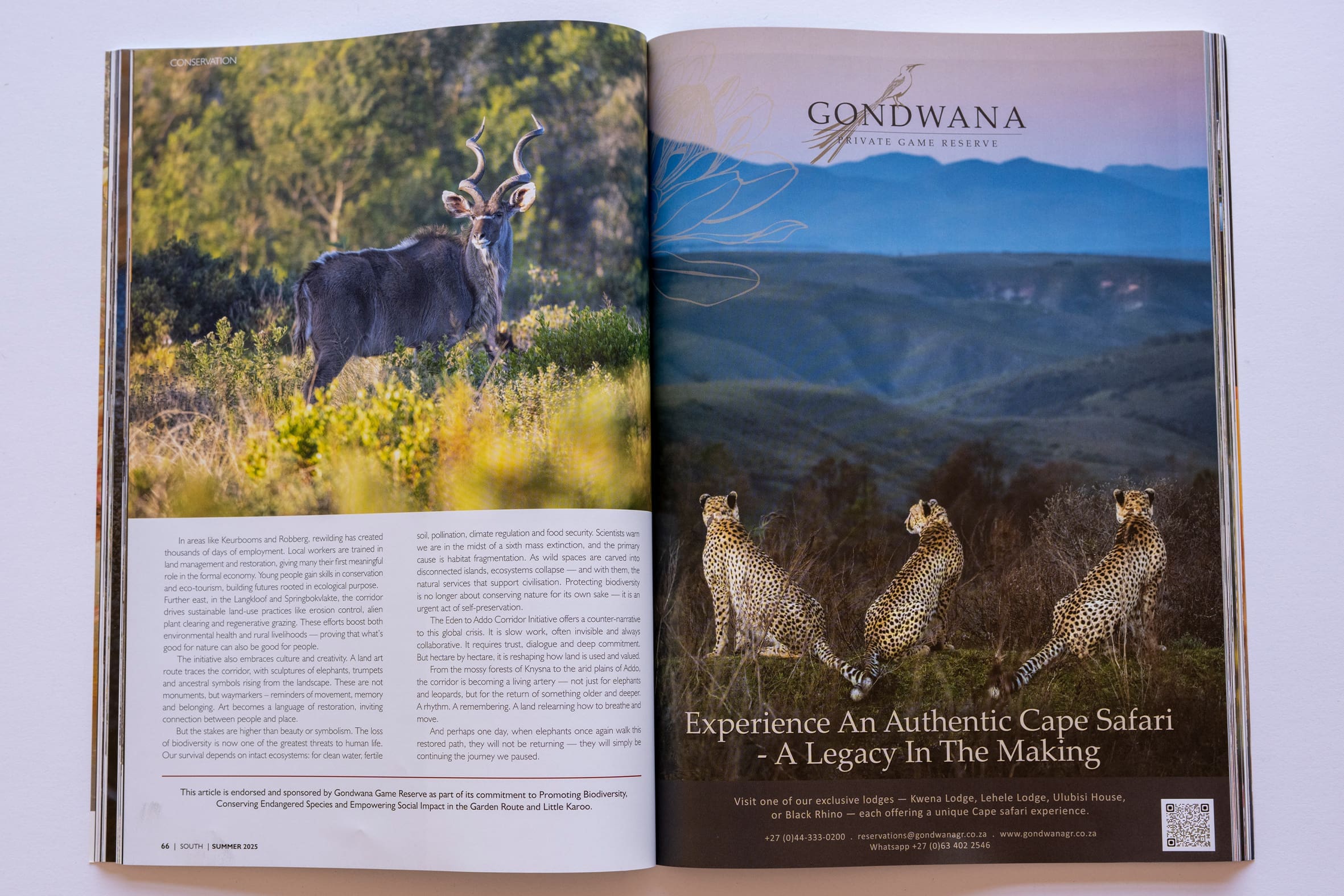
This story was adapted from an article originally published in a regional magazine exploring the Eden to Addo Corridor Initiative and its role in reconnecting fragmented landscapes across the southern Cape.

As published in SOUTH Magazine - Photography by Raquel de Castro Maia
As published in SOUTH Magazine
As published in SOUTH Magazine - Photography by Raquel de Castro Maia

Behind the Story

What is the Eden to Addo Corridor Initiative?

A 400-kilometre conservation corridor connecting the Garden Route, Baviaanskloof and Addo Elephant National Park, working to reconnect fragmented habitats across five of South Africa's nine biomes, from forest and fynbos to thicket and karoo.

Who is the lone elephant of the Knysna Forest?

Believed to be the last truly wild elephant in South Africa, she has become a symbol of both the resilience and the isolation this corridor is working to change.

How does the corridor actually get built, if it crosses private land?

Largely through biodiversity stewardship agreements, where landowners voluntarily bring their farms into a wider conservation network, rather than land being formally purchased or expropriated.

Did elephants ever roam this coastline?

Yes. Fossil trackways found between Arniston and Robberg show elephants used these coastal dunes repeatedly for hundreds of thousands of years, evidence that this corridor is reopening a path that was theirs long before it was anyone else's.

Do you take on editorial commissions like this one?

Yes. Field Stories often begin as magazine or publication work, and I'm always interested in landscape-scale conservation stories that go beyond a single species.

Species fact files

Fact file

African Bush Elephant

Loxodonta africana

Genus Loxodonta · Elephantidae

Endangered

Habitat
Diverse sub-Saharan habitats, savanna grassland, woodland, forest, wetland and farmland, from sea level to mountain slopes
Lifespan
Up to 70–75 years in the wild

Key facts

  • The largest living land animal: adult bulls stand roughly 3.0–3.4 m at the shoulder and weigh about 5.2–6.9 tonnes.
  • Both sexes grow ivory tusks throughout life; the longest recorded tusk measured 3.51 m and weighed 117 kg, the trait that drives the poaching crisis.
  • Herds are matriarchal: a family unit is led by the oldest female, who guides the group to food and water and coordinates cooperative care of calves.
  • Assessed for the first time as a species separate from the forest elephant in 2021 and listed as Endangered, with over 60% of the savanna population estimated lost since 1965.
RangeSub-Saharan Africa